
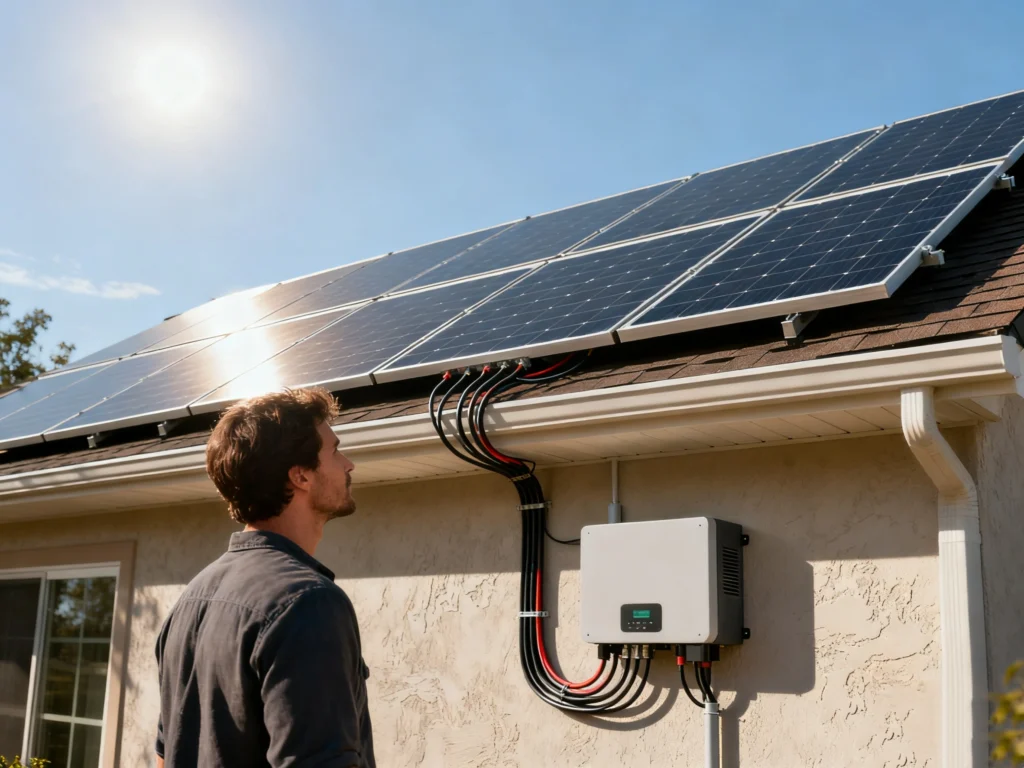
When designing a solar system, homeowners understandably spend a lot of time thinking about the number of solar panels and the size of the battery.
The inverter often gets less attention.
Yet the inverter is one of the most important pieces of equipment in the entire system.
A common question we hear is:
“If I’m installing 10 kW of solar panels, shouldn’t I also have a 10 kW inverter?”
Not necessarily.
In fact, in many cases it makes good sense for the solar panel capacity to be larger than the inverter capacity.
Understanding why requires a quick explanation of what the inverter actually does.
What does a solar inverter do?
Solar panels generate electricity as DC – direct current.
Your home and the electricity grid primarily operate using AC – alternating current.
The solar inverter sits between the two and converts the electricity generated by your solar panels into electricity that can be used by your home, stored in a compatible battery system or exported to the grid.
You can think of the inverter as the engine room of the solar system. The solar panels collect the energy. The inverter controls how that energy is converted and delivered.
Modern hybrid inverters may also manage the interaction between:
Solar -> Home -> Battery -> Grid
That makes correct inverter selection particularly important when solar and battery storage are being designed together.
Solar panel size and inverter size are not the same thing
This is probably the most important concept to understand.
Let’s say your roof has 10 kW of solar panels installed.
That doesn’t necessarily mean those panels will regularly produce 10 kW of electricity at exactly the same moment.
The rated capacity of a solar panel is measured under standardised laboratory test conditions.
Real-world conditions are different.
Solar production changes throughout the day depending on factors such as:
- time of day;
- season;
- panel orientation;
- roof pitch;
- temperature;
- cloud cover;
- shading; and
- where the property is located.
A 10 kW solar array might therefore spend much of its operating time producing considerably less than 10 kW.
This is one reason solar systems are commonly designed with more panel capacity than inverter capacity.
Why would you put more solar panels on a smaller inverter?
Imagine a simplified example.
A homeowner has:
10 kW of solar panels
connected to an:
8 kW inverter
At first glance, it may seem as though 2 kW of the solar system is being wasted. That’s not how it works.
During the morning, afternoon, winter and less-than-perfect weather conditions, those additional panels help the solar system reach useful production levels earlier and remain productive for longer.
The inverter may only reach its maximum output during the strongest solar-production periods.
So instead of designing exclusively around the highest possible momentary solar output, we’re interested in maximising useful electricity generation across the entire day and throughout the year.
What is inverter clipping?
There can be occasions when the solar panels are capable of producing more power than the inverter can convert at that moment.
When this happens, the inverter operates at its maximum output and the additional potential solar generation is limited.
This is commonly referred to as clipping.
For example, an 8 kW inverter can’t continuously deliver 9 kW of AC output simply because the solar panels happen to be capable of producing it.
That sounds undesirable, but some clipping isn’t necessarily a bad thing.
A well-designed system may sacrifice a relatively small amount of potential generation during occasional peak conditions in return for stronger solar production across many more hours of the year.
The question isn’t:
“Will this system ever clip?”
A better question is:
“Which combination of panels and inverter gives this property the best overall energy production and value?”
Bigger isn't automatically better
It can be tempting to simply choose the largest inverter available.
But there may be little benefit in paying for inverter capacity that the solar array rarely uses.
There are also other considerations.
A larger inverter can affect:
- network approval;
- export limits;
- system cost;
- phase balancing;
- battery compatibility;
- backup capability; and
- how the overall solar and battery system should be configured.
This is why inverter sizing should be part of the overall design rather than simply matching the inverter number to the solar-panel number.
Your roof layout matters
Not every panel on your roof produces maximum electricity at the same time.
Consider a home with panels facing both east and west.
The east-facing panels produce strongly earlier in the day.
The west-facing panels produce strongly later in the day.
Because the two arrays peak at different times, the combined 10 or 12 kW of panel capacity may rarely produce its full rated capacity simultaneously.
This can make a larger solar-panel array paired with a somewhat smaller inverter particularly effective.
The system generates electricity across a broader part of the day rather than producing one large midday peak.
For households, that can be very useful because the objective isn’t simply to generate the biggest number at noon.
It’s to produce useful electricity when the home needs it.
North, east and west can produce different design outcomes
Panel orientation therefore affects inverter sizing.
A predominantly north-facing solar array may have a stronger concentrated production peak around the middle of the day.
An east-west system may have a wider and flatter production curve.
Shading can influence the outcome again.
This is why two neighbouring homes with the same number of panels might legitimately be designed with different inverter configurations.
Good solar design starts with the actual property.
because they are cheaper.
What about a battery?
Adding a home battery introduces another important consideration.
With many modern systems, the inverter – or power conversion equipment within the overall battery system – also influences how quickly energy can move into and out of the battery.
That means there are actually two related questions:
How much energy can my battery store?
and:
How much power can my system deliver at one time?
These are not the same thing.
A large battery may hold plenty of energy but still be limited by the power capability of the inverter and battery system.
For example, the design needs to consider whether the system needs to simultaneously support loads such as:
- air conditioning;
- induction cooking;
- pool equipment;
- electric hot water;
- EV charging; and
- other large electrical appliances.
Manufacturers themselves specify different power limits according to inverter model and battery configuration.
Backup power can affect inverter selection
If blackout protection is an important goal, inverter sizing deserves even more attention.
During normal operation, the electricity grid can supplement your solar and battery whenever your household demand exceeds what the system can provide.
During a blackout, that grid support disappears.
Your solar-and-battery system must therefore supply the backed-up loads itself.
This means we need to consider both:
Energy – how long the battery can run the home.
and:
Power – how much equipment can operate simultaneously.
A 30 kWh battery may contain plenty of stored energy.
But if the system can only provide a certain amount of power at one time, you can’t necessarily run every large appliance simultaneously during an outage.
That’s an important principle regardless of which battery brand is being considered.
Single-phase or three-phase?
The electrical supply to the property also influences inverter selection.
Australian homes can have either:
single-phase power
or:
three-phase power.
For larger solar and battery systems, three-phase properties can create additional design options – and additional considerations.
Some equipment is specifically designed as a three-phase solution.
Other battery systems use different architectures.
The right answer depends on the property, network requirements, existing switchboard, household loads and the equipment being installed.
This is one reason simply asking:
“Should I have a 5 kW, 8 kW or 10 kW inverter?”
doesn’t provide enough information.
The electricity network can also impose limits
Your electricity distributor has rules governing how solar and battery systems connect to the grid.
Depending on the property and network, there may be limits or conditions around:
- inverter capacity;
- export capacity;
- phase configuration; and
- how the inverter communicates with or responds to the network.
Approved equipment must also comply with Australian requirements.
This is another reason inverter size cannot simply be selected from a catalogue.
The proposed system needs to be technically appropriate and acceptable for the property’s grid connection.
Export limits don't necessarily mean you should install less solar
This is another common misconception.
Suppose a property is limited in how much solar electricity it can export to the grid.
That doesn’t automatically mean installing additional solar panels is pointless.
Your home may still use solar electricity directly.
A compatible battery may absorb excess energy.
And having additional panels can improve generation during mornings, afternoons, winter and poorer weather.
So:
solar-panel capacity, inverter capacity and grid export capacity are three different things.
They all need to be considered together.
Future plans matter too
Just like battery sizing, inverter sizing should take reasonable future requirements into account.
Perhaps you don’t have a battery today but intend to add one later.
Or you may be planning:
- an EV;
- heat-pump hot water;
- induction cooking;
- more air conditioning;
- a pool;
- a home extension; or
- further electrification of the property.
In those cases, choosing the cheapest or smallest inverter that meets today’s needs may not necessarily be the best long-term decision.
In some circumstances, a hybrid inverter or a different system architecture may provide greater flexibility later.
But equally, there is no benefit in dramatically oversizing equipment purely for hypothetical future requirements.
Good design means making sensible allowances for changes that are realistically likely to happen.
So how do we choose the right inverter?
At AG Solar, inverter sizing isn’t based on a single rule.
We consider the complete energy system, including:
The solar array
How many panels are being installed and what is their total capacity?
Roof orientation
Are the panels north-facing, east-west or spread across several roof faces?
Shading
How will shading affect production at different times of the day and year?
The property electrical supply
Is the home single-phase or three-phase?
Household loads
How much power does the home require and when?
Battery requirements
Is a battery being installed now, or is one likely to be added later?
Backup expectations
What does the homeowner actually expect to operate during a blackout?
Network requirements
What inverter and export conditions apply at the property?
Future electricity consumption
Are EVs, electric hot water or other major loads likely to be added?
Only after considering these factors does the appropriate inverter size become clear.
Don't judge a solar system by the inverter number alone
10 kW of panels + 10 kW inverter
is superior to:
10 kW of panels + 8 kW inverter.
Either design could be correct.
Either could also be wrong.
The answer depends on the property and the objective of the system.
A well-designed solar and battery system isn’t a collection of the biggest components that will fit.
It’s a group of components that have been deliberately selected to work together.
At AG Solar, we design the solar panels, inverter, battery and electrical system as one complete home-energy solution.
If you’re comparing different solar or battery proposals and aren’t sure why different inverter sizes have been recommended, speak with the AG Solar team.
We’ll explain the reasoning behind the design – because you should understand not only what we’re recommending, but why we’re recommending it
